
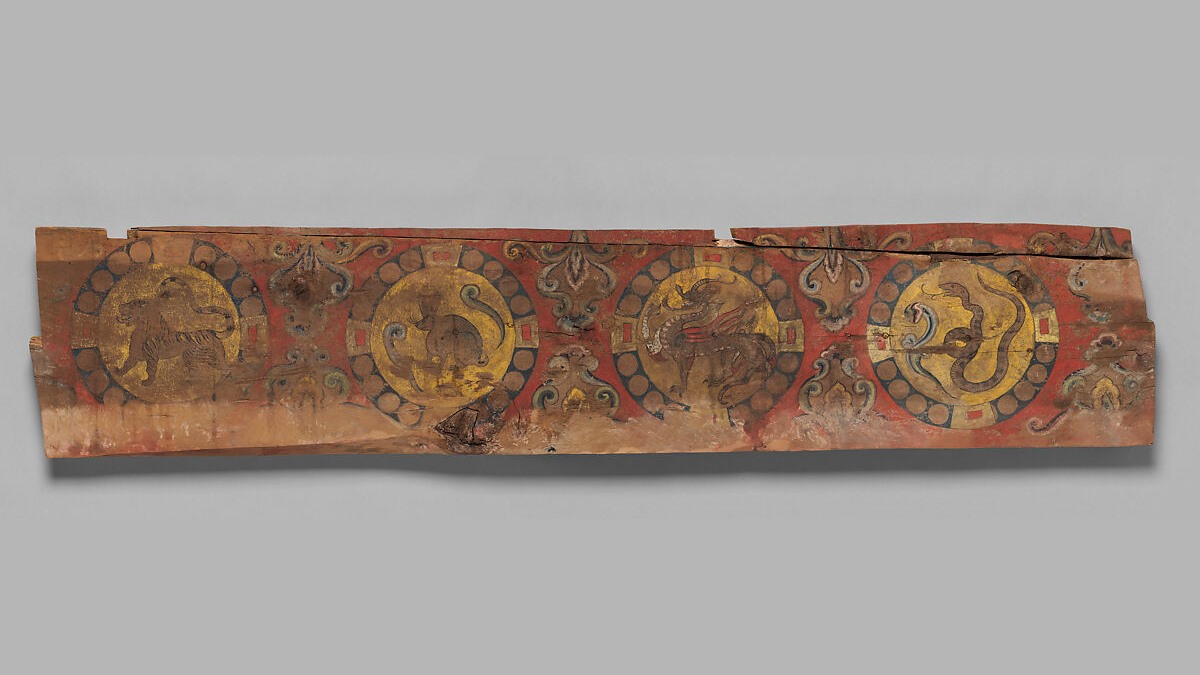
A Story Can Explain an Order Without Recording an Origin
The Great Race does not give us a founding record for the Chinese zodiac. It gives the animal order a memorable story. A Qin daybook (日书, rìshū) — a manuscript used for calendrical and divinatory choices, such as judging days and interpreting events — and a Han text illuminate a different question: which branch–animal pairings were written down in particular sources?
Read those sources at their own scale, and the question becomes clearer: what can a story, a daybook, and a classical passage each show?
Keep the evidence at its own scale
Quick answer
A folk tale can explain why a sequence is easy to remember. A manuscript can show how one source paired branches and animals. A classical passage can show which associations it uses in that passage. None of those things, alone, names an inventor or settles every origin question.
That distinction leaves room for the story without asking it to do a historian’s job. For the narrative itself, see the Great Race legend. The question here is narrower: what kind of claim can the surviving evidence support?
What each kind of source can actually show
| Source type | What it can help explain | What it cannot settle |
|---|---|---|
| Great Race folklore | How a familiar animal order can be narrated, remembered, and retold with different details | Who designed the calendar system or the date when it began |
| A daybook manuscript | Which branch–animal associations appear in that particular written source | One final, unchanging list for every place and period |
| A classical passage | Which associations are present in the passage and its textual setting | A named inventor, or an exact moment of standardization |
Reading sources this way avoids two opposite mistakes: treating every folktale as a historical record, or acting as if a documented story has no cultural value because it is not one.
The surviving Shuihudi list is not identical to the modern list
A National Museum of China account describes a Qin daybook from Shuihudi in which several associations differ from the familiar later sequence. A more detailed transcription published by the China Digital Science and Technology Museum makes the point visible.
| Branch | In the cited Shuihudi transcription | In the familiar later sequence |
|---|---|---|
| 辰 | No animal name is recorded in the cited list | Dragon |
| 午 | Deer | Horse |
| 未 | Horse | Goat / Sheep |
| 戌 | 老羊 (lǎo yáng; interpretation disputed) | Dog |
This does not turn the daybook into a failed version of the modern zodiac. It gives us a more useful fact: branch–animal pairings were already being written down, while the surviving material still contains differences a modern chart tends to hide.
Another daybook keeps the question open
A transcription of a Fangmatan daybook published by Fudan University’s Center for Research of Excavated Classics preserves another set of readings. The surviving transcription reads 辰 as 虫, 巳 as 鸡, and 申 as 石. Scholars disagree over whether some of these are literal associations, scribal errors or variants, or labels that need to be understood through other technical systems.
The surviving transcriptions do not simply reproduce one modern-looking list.
The manuscripts are witnesses to particular uses and texts, not a vote on which tradition is “the original.”
That is why the details matter. A daybook can preserve a historical text and its recorded associations without becoming a timeless rulebook for every later reader.
What Lunheng adds — and what it does not
In the Wushi passage of Lunheng, eleven familiar branch–animal associations appear; Dragon is not among the examples in that passage. A separate Yandu passage says 辰为龙,巳为蛇 — “Chen is Dragon; Si is Snake.”
Taken together, the two passages show the familiar twelve associations in a Han text. They do not say that Wang Chong invented them, nor do they provide a single date at which every earlier variant disappeared.
What remains open
The sources here do not establish one creator, one first Great Race telling, or one moment when every branch acquired its familiar animal. They do show something more useful than a tidy legend: different kinds of evidence answer different parts of the question.
Folklore has a different job: it gives people a way to carry the order through retelling, even when it does not function as an archive of institutional beginnings. For the broader calendar-and-folklore picture, see the Chinese zodiac origin guide; for other kinds of conflicting answers, see why zodiac answers can differ.
Five questions for any zodiac origin claim
- What kind of source is this? A story, a manuscript, a museum record, and a later explanation do not carry the same kind of evidence.
- What does it directly record? A branch–animal pairing is not the same as an account of who created it.
- Does the source preserve its setting? Date, findspot, passage, and collection context can matter as much as the animal name.
- Is the conclusion larger than the evidence? “This text contains a pairing” is a smaller claim than “this text proves the whole system began here.”
- Does another source show a different arrangement? If it does, the difference may be part of the history rather than a mistake to erase.
Follow the question to the right guide
Frequently asked questions
Did the Great Race create the Chinese zodiac?
No. It is a folk explanation for the animal order, not a historical record that names the creator or founding moment of the zodiac system.
Does the cited Shuihudi transcription match the modern twelve-animal list?
Not exactly. The surviving text includes readings such as Deer at Wu, Horse at Wei, and no named animal at Chen. Other readings, including 老羊 (lǎo yáng), are interpreted differently by scholars.
Does the Wushi passage of Lunheng include Dragon?
Not in the set of examples used in that passage. A separate Yandu passage states that Chen is Dragon and Si is Snake, so the two passages should be read together.
Is there one known inventor of the Chinese zodiac?
The sources discussed here do not name one. They preserve parts of a much longer history rather than a single founding record.
Do different early lists mean the modern zodiac is wrong?
No. They show that surviving materials have their own contexts and histories. A difference in an early source is evidence to understand, not an automatic correction to every later practice.