
Chinese zodiac jade From a horse with a fan to a circle of twelve
In a photograph of twelve Qing jade figures at the Metropolitan Museum of Art, the Horse is seated and holding a broad leaf fan. Find it in the middle row, third from the left. The fan helps you recognise one carving. A Qing imperial box in Taipei gives the animals a different job: their places around the box show how the twelve signs fit into a cycle.
Find the horse with the leaf fan
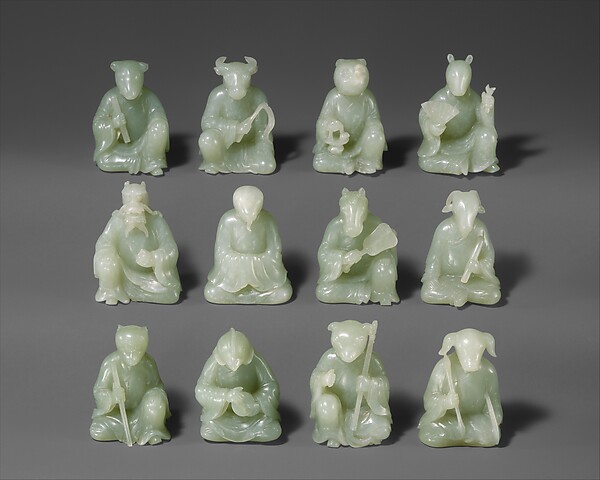
The figures in the Met’s set have a catalogue height of about 5.7 centimetres per figure. In the photograph, the Horse wears a robe, as do its neighbours. Its long face and the fan angled across its lap do more to pick it out than its seated pose. The museum points to the different objects and poses as ways the carvers gave each member of the group an identity. The fan is a clue to this figure, specific to this set.
The figures in this photograph are arranged in a grid so you can see them together. The layout gives the Horse a place in the photograph. The imperial box goes a step further: the place where each figure sits inside it is part of the design.
How a box gives twelve animals an order
The Qianlong-era Myriad Cycles curio box at the National Palace Museum has twelve sides. The lid carries the twelve Earthly Branches, the old sequence of signs used for marking time. Inside, twelve jade animals follow one another clockwise around a square jade case that holds an album. The same sequence appears twice, once in writing on the outside and once in animals on the inside.
That arrangement is the part a photograph of a single carving leaves out. The Rat is the first animal in the usual sequence and the Horse is the seventh. Their position in the sequence matters here because the twelve animals stand for twelve branches. Around those written signs, the lid also carries a hundred versions of the character for longevity. The National Palace Museum reads those characters as a wish for long life. The design sets that wish around the names of the repeating cycle.
Where the circle survives in pieces
On the museum’s Jade Ring Composed of the Chinese Zodiac, the record supplies a detail the surviving object cannot fully show by itself. It describes twelve carved animals and records damage to the piece. The catalogue gives a maximum outer diameter of 20 centimetres. The record dates it to the late Ming through the early Qing and notes a brocade case. The catalogue is more specific about the design and condition than about how the piece was used.
In the imperial box you can read the animal order against the writing on the lid. With the damaged ring, the museum’s description preserves the design even where the carving is interrupted. Set these beside the Met’s horse and the difference becomes clear: a jade figure can have an individual look, while the complete zodiac depends on how the animals belong together.
What a single jade animal can tell you
A horse shape is enough to describe a jade horse. Call it a zodiac Horse when the collection record, its companions, or the original arrangement connects it with the twelve signs. For a different question such as the sign for a birth date, use the zodiac years chart. A January or early-February birthday can still fall on the preceding side of the Lunar New Year boundary.
Questions about Chinese zodiac jade
Which figure holds the fan in the Met’s jade zodiac set?
The Horse carries a broad leaf fan. In the group photograph shown here, it is third from the left in the middle row.
Why are the jade animals arranged in a circle in the Myriad Cycles box?
The twelve animals represent the twelve Earthly Branches, whose names also appear on the lid.
Does the damaged jade ring still tell us what it was designed to show?
Yes. The National Palace Museum records a design of twelve zodiac animals and describes the surviving object as damaged.