
Ben Ming Nian: Is Your Chinese Zodiac Year Bad Luck?
Ben Ming Nian (本命年) translates literally as “one’s own zodiac year.” It arrives every 12 years, when the animal sign of the current calendar year matches the animal sign of your birth year. The Horse person born in 1990, for instance, meets a Horse-year Ben Ming Nian in 2002, 2014, and 2026.
In Chinese folk tradition, Ben Ming Nian is understood as a year for extra awareness — red clothing, cautious decisions, and attention to balance. Not because the year is “unlucky.” The more accurate reading is that your own sign returning feels symbolically amplified, so people pay closer attention to protection, restraint, and steady choices during that twelve-month stretch.
Ben Ming Nian at a glance
| Question | Answer |
|---|---|
| What it means | Your own zodiac year — the animal of the current year matches your birth-year animal. |
| How often | Every 12 years, because the Chinese zodiac has 12 animal signs. |
| Key ages | 12, 24, 36, 48, 60, 72, etc. (depends on the exact lunar-year boundary in your birth year). |
| Common custom | Wearing red — underwear, socks, belts, bracelets — as symbolic protection. |
| What it isn’t | A prediction of bad luck, a curse, or a reason to avoid making decisions. |
| Full cycle return | The exact stem-branch combination (e.g., Fire Horse, Water Rat) repeats every 60 years, not 12. |
How Ben Ming Nian works
The Chinese zodiac assigns one animal to each year in a repeating 12-sign cycle. Your Ben Ming Nian is simply the year in that cycle that matches your birth-year animal. The 2026 Horse year, for example, is Ben Ming Nian for anyone born under the Horse sign — provided their birth date falls within the Horse year’s lunar boundary, not the Gregorian one.
Here’s every sign’s Ben Ming Nian pattern for the current span of years:
| Birth sign | Recent Ben Ming Nian years | Watch out for |
|---|---|---|
| Rat | 2008, 2020, 2032 | Birthday before or after Chinese New Year in your birth year |
| Ox | 2009, 2021, 2033 | The element changes every 60 years, even though the animal returns every 12 |
| Tiger | 2010, 2022, 2034 | Use the zodiac-year range, not January 1 – December 31 |
| Rabbit | 2011, 2023, 2035 | January and February birthdays need special attention |
| Dragon | 2012, 2024, 2036 | Ben Ming Nian = 12-year animal return; full stem-branch return = 60 years |
| Snake | 2013, 2025, 2037 | Snake year starts at Chinese New Year, not January 1 |
| Horse | 2014, 2026, 2038 | 2026 is Ben Ming Nian for Horse people by the lunar boundary |
| Goat | 2015, 2027, 2039 | Goat, Sheep, and Ram are all translations of 羊 |
| Monkey | 2016, 2028, 2040 | Animal repeats every 12 years |
| Rooster | 2017, 2029, 2041 | The New Year boundary still matters for early-year births |
| Dog | 2018, 2030, 2042 | Don’t use the Gregorian year alone for January/February birthdays |
| Pig | 2019, 2031, 2043 | Pig year boundaries shift with Chinese New Year |
Still unsure about your sign? Use the Chinese Zodiac Calculator or check the Chinese Zodiac Years Chart before pinning down your Ben Ming Nian.
Why Ben Ming Nian is treated with caution
The folk explanation goes like this: when your own animal sign returns, the year is said to feel more exposed — like the energy of that sign is at full volume. People may notice more conflict, health wobbles, work pressure, family friction, or relationship tension during a Ben Ming Nian year.
None of this is a guarantee. The tradition is closer to a cultural reminder: don’t act careless, don’t invite unnecessary risk, and take stock of your choices when the year carries your own sign. “Bad luck year” is the shortcut version, and it misses the nuance.
You’ll also hear a far starker version from older relatives — the warning that a Ben Ming Nian is a “threshold” year (槛, kǎn), and, in its grimmest telling, a year when sudden misfortune is more likely. I’m mentioning it because plenty of people grew up hearing it. But treat it for exactly what it is: an old superstition with no evidence behind it, not a prediction about anyone’s real year. If it stirs up genuine worry, that’s the signal to set it down — the tradition is meant to prompt a little care, never dread.
Why do people wear red in Ben Ming Nian?
Red in Chinese culture carries associations with celebration, vitality, protection, and auspicious energy. During one’s own zodiac year, red clothing and accessories are worn as a symbolic gesture of protection and confidence. The most common examples: red underwear, red socks, red belts, red bracelets, red strings, and even red-dyed eggs in some regional traditions.
These customs vary widely. Some families treat them seriously, with elders preparing red items for younger members. Others treat the whole thing as a light family tradition — a red pair of socks from a parent is more about care than superstition.
Does the red item have to be given by someone else?
Popular belief sometimes holds that a red item for Ben Ming Nian should be gifted — by an elder, a partner, or a close family member — rather than self-purchased. This isn’t a universal rule, but it reflects the social dimension of the custom: protection is imagined as something connected to family care and blessing, not just a personal choice.
Red socks and “stepping on the petty people”
One custom deserves its own mention, because it’s wonderfully specific: the red socks. In many families — mine included — a mother starts laying out the red things as New Year’s Eve gets close: red underwear, red socks, sometimes a red belt, all ready before the year turns. The socks are the charming part. Some are printed on the sole with a little human figure — a 小人 (xiǎo rén), the “petty person” who gossips, schemes, or gets in your way. The idea is that all year you are quite literally stepping on the petty people, keeping them underfoot where they can’t do you harm.
It isn’t a modern gimmick, either: the Qing-dynasty almanac Yanjing Suishi Ji (燕京岁时记) already noted the northern habit of dressing head-to-toe in red and “treading on the petty people” to keep misfortune away. Take it seriously or just enjoy it — either way, a pair of red socks from your mum is a small, warm piece of the tradition.
Ben Ming Nian and Tai Sui (太岁)
Here’s the piece that ties the whole “be a little careful” feeling together — and the part most English explanations skip: Tai Sui (太岁), the Grand Duke of the year.
In folk belief, Tai Sui is the deity in charge of the year, tied to the roughly twelve-year orbit of Jupiter — which is how the idea lines up with the twelve animals. Tradition counts sixty Tai Sui generals, one for each year of the full stem-branch cycle, each taking a turn “on duty.” When your own sign matches the year’s, you sit on the same axis as the ruling Tai Sui — a state called 值太岁 (zhí tài suì). That is precisely what a Ben Ming Nian is, and it’s the traditional reason the year is treated as one to handle with a bit more care.
Appeasing Tai Sui: 拜太岁 and the paper charm
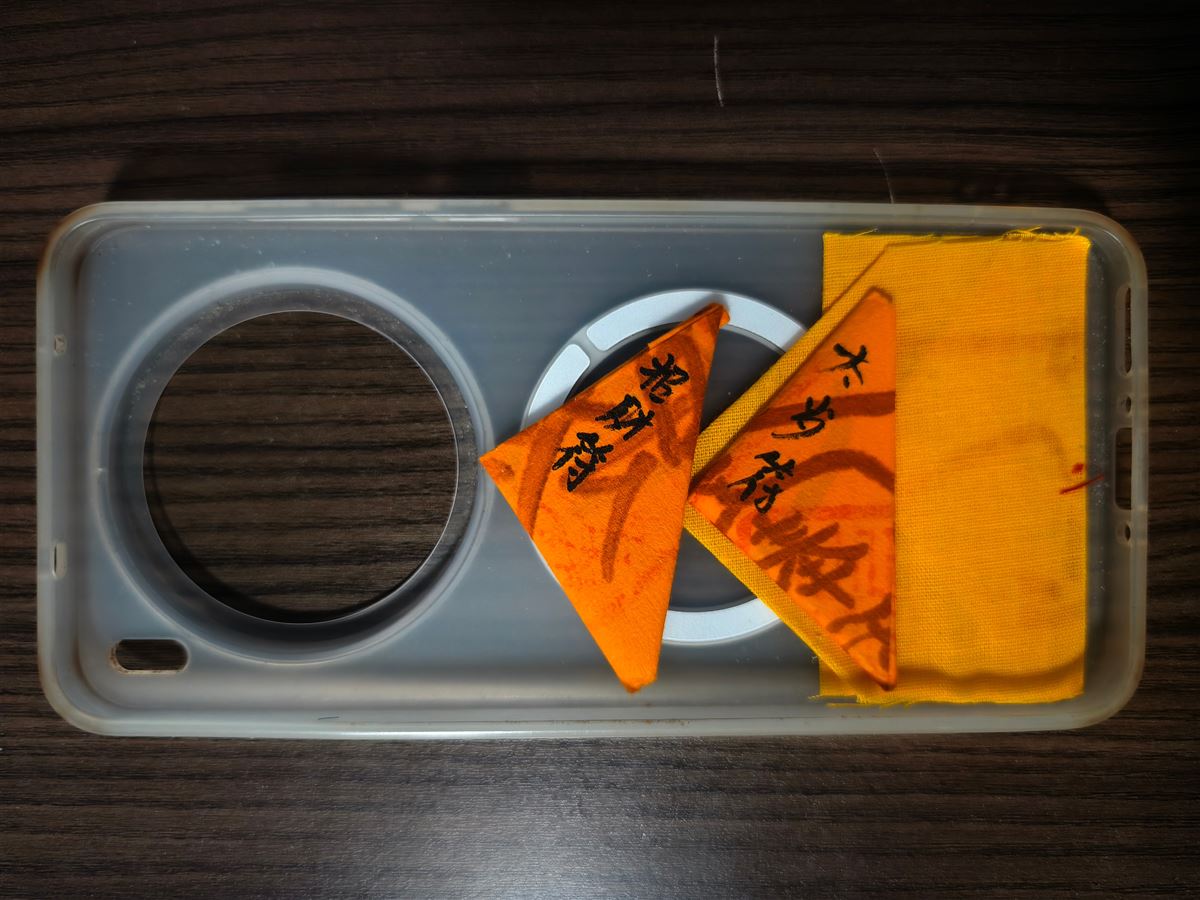
Where the red customs are about protecting yourself, Tai Sui customs are about staying on good terms with the year. Near the Lunar New Year, people traditionally visit a temple to 安太岁 / 拜太岁 (ān / bài tài suì) — to pay respects to that year’s general and ask for a smooth run. Many also carry a Tai Sui talisman (太岁符), a paper charm prepared at a temple or by a Daoist priest.
I’ll be honest: for a lot of people this isn’t abstract at all. A Tai Sui talisman is a very ordinary, everyday object — the paper charm you ask a Daoist priest for, then carry around all year tucked inside a wallet or a phone case, quietly doing its job. Often it isn’t alone, either — it rides alongside a couple of companions, a charm for wealth (招财符) and one for peace (平安符), a small set folded into one corner of the case. It’s one of those things you only notice once you know to look.
Ben Ming Nian at different ages
Because the animal cycle runs 12 years, Ben Ming Nian tends to hit at 12, 24, 36, 48, 60, and 72 — roughly every milestone decade of life. Each age bracket brings its own reading:
| Age | Life stage | Traditional reading |
|---|---|---|
| 12 | Early adolescence | A symbolic return during school transitions and identity formation. |
| 24 | Early adulthood | Often linked to career starts, independence, and relationship choices. |
| 36 | Established adulthood | A reminder to check in on work, family, health, and long-term direction. |
| 48 | Midlife responsibilities | Traditionally a year for steady decisions and avoiding unnecessary risk. |
| 60 | Full cycle completion | The most significant — both the animal and the full stem-branch combination return. |
The age-60 return carries extra weight in Chinese tradition. It’s not just the animal returning — it’s the exact Heavenly Stem and Earthly Branch pair from the year of your birth, completing the full 60-year sexagenary cycle. In many families, the 60th birthday is celebrated as a meaningful milestone, marked by a full-cycle banquet and family gatherings known as huà jiǎ (花甲).
Ben Ming Nian vs. the 60-year cycle
There’s a common confusion here, and it’s worth untangling. Ben Ming Nian tracks the 12-year return of your zodiac animal. The 60-year cycle tracks the return of an exact Heavenly Stem plus Earthly Branch combination — which means it tracks the element layer too.
| Concept | Cycle length | What returns? |
|---|---|---|
| Ben Ming Nian | 12 years | Your zodiac animal returns. |
| Stem-branch (element) year | 60 years | The exact Heavenly Stem + Earthly Branch combination returns. |
| Example | Horse every 12 years; Fire Horse every 60 | A Horse person has Ben Ming Nian in any Horse year, but the exact Fire Horse combination is a once-in-a-lifetime event. |
For the full element layer, see The Five Elements in Chinese Zodiac. For year-by-year labels, use the Chinese Zodiac Years Chart.
Common mistakes about Ben Ming Nian
Mistake 1: Treating it as purely bad luck
Ben Ming Nian is associated with caution, but “unlucky year” flattens the concept. It loses the tradition’s real texture: awareness, protection, reflection, and restraint as meaningful practices, not just superstition.
Mistake 2: Using January 1 as the start date
Your Ben Ming Nian follows the Chinese zodiac year, not the Gregorian calendar. For anyone with a January or February birthday, this distinction can change the animal sign entirely.
Mistake 3: Forgetting the element layer
The animal returns every 12 years, but the full element-animal pair returns every 60. These two cycles are related — but they’re not the same thing.
Mistake 4: Treating red items as guarantees
Red customs are meaningful cultural symbols. They’re not a shield against problems and don’t replace medical, financial, or relationship judgment.
How to approach Ben Ming Nian practically
Ben Ming Nian is most useful when it encourages reflection rather than worry. Here’s what that looks like in daily terms.
Healthy ways to read it
- Review major plans before making fast decisions.
- Pay closer attention to health routines, sleep, and stress.
- Use red customs as cultural symbols that feel meaningful to you and your family.
- Treat the year as a prompt to steady yourself, not a sentence of bad outcomes.
Less helpful ways to read it
- Postponing every big decision because it’s your zodiac year.
- Assuming the year must include conflict or loss.
- Using zodiac warnings to override medical, legal, financial, or relationship advice.
Ben Ming Nian FAQ
What does Ben Ming Nian mean in Chinese?
Ben Ming Nian (本命年) means “one’s own zodiac year.” It refers to the year in the 12-year cycle when the current zodiac animal matches your birth-year animal.
How often does Ben Ming Nian happen?
Every 12 years, because the Chinese zodiac repeats on a 12-animal cycle.
Is Ben Ming Nian really unlucky?
No. It is traditionally read as a year for caution and symbolic protection, but it is not a prediction of bad luck. The cultural meaning is closer to awareness than doom.
Why do people wear red during Ben Ming Nian?
Red symbolizes protection, celebration, and vitality in Chinese culture. Wearing red during one’s zodiac year is a symbolic custom — not a requirement, not a guarantee.
Does Ben Ming Nian start on my birthday?
No. It follows the Chinese zodiac year boundary, which begins at Chinese New Year. Both your birthday and the zodiac-year boundary matter for accuracy.
Why is age 60 special in Ben Ming Nian?
Age 60 marks the return of the full 60-year stem-branch cycle, not just the 12-year animal cycle. It’s the only age where the exact Heavenly Stem and Earthly Branch combination from your birth year returns.
Does Ben Ming Nian affect everyone the same way?
No. Folk tradition treats it as a general reminder for caution, but individual experience depends on life stage, family background, and personal circumstances. There is no fixed outcome.
What is Tai Sui, and how does it relate to Ben Ming Nian?
Tai Sui (太岁) is the folk “god of the year,” linked to Jupiter’s twelve-year cycle, with sixty generals said to take yearly turns. In your own zodiac year your sign shares the year’s axis — a state called 值太岁 (zhí tài suì) — which is the traditional reason a Ben Ming Nian is treated with extra care. It’s folk belief, not a forecast.
What is An Tai Sui or a Tai Sui talisman?
An Tai Sui (安太岁 / 拜太岁) is the custom of visiting a temple near Lunar New Year to pay respects to the year’s Tai Sui general and ask for a smooth year. A Tai Sui talisman (太岁符) is a paper charm from a temple or a Daoist priest that people carry through the year. Both are symbolic traditions, not guarantees.
Next steps
Not sure whether this year is your Ben Ming Nian? Start by confirming your exact Chinese zodiac sign, then check it against the current zodiac year.
Get a personalized report that maps your exact animal, element, and compatibility — including your Ben Ming Nian years.
Editorial note: The lunar-year boundaries, stem-branch names, and 60-year cycle data on this page are calendar facts verifiable against Chinese almanacs and historical records. All interpretations of Ben Ming Nian as a time for caution, protection, and awareness reflect Chinese folk tradition and cultural symbolism. They are not predictions, not medical or financial advice, and should not be treated as fixed outcomes for any individual.